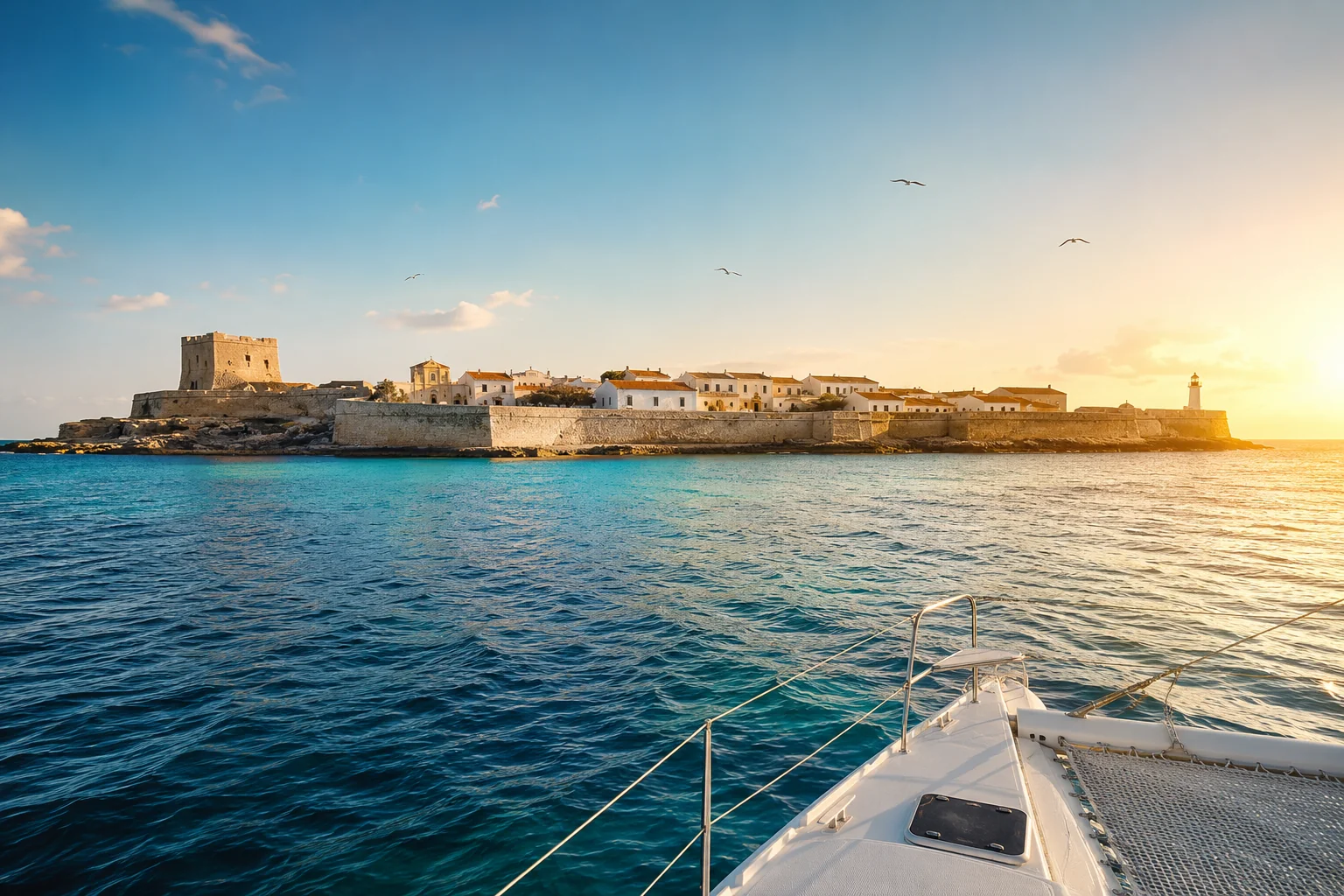
Tabarca Island from Santa Pola: A Practical Day Trip Guide (2026)
In short: Tabarca is the only inhabited island in the Valencian Community and Spain's first marine reserve. The catamaran from Santa Pola gets you there in 25 minutes. Between 2 March and 31 October it runs ten times a day, with a round-trip ticket from around €9 online (2026 prices), flexible, valid for any return that day. Sixty people live here, with 18th-century walls, a lighthouse, beaches, and restaurants famous for caldero tabarquino, a slow-cooked fish stew with rice. A perfect day trip, but plan your return: the last ferry leaves at 19:15, and there are no ATMs, supermarkets, or pharmacies on the island.
Santa Pola is the closest port to Tabarca anywhere in Spain, closer than Alicante. From our apartment it's a ten-minute walk to the embarcadero (ferry jetty). Hop on the morning ferry, you're on the island by 10:25, with a full day for sightseeing, snorkeling, and lunch before catching dinner back in town. This guide gathers everything worth knowing before your first trip: operators, 2026 prices, marine-reserve rules, ferry schedule, what to watch out for.
Tabarca: what it is and why it's worth the trip
Tabarca is a small island off the coast of Santa Pola on the Costa Blanca, Spain. The only inhabited island in the Valencian Community and Spain's first marine reserve (since 1986). It lies about 9 km from the port of Santa Pola and 20 km from Alicante. Cabo de Santa Pola is only 4.3 km away. The island covers a little over 30 hectares, with a length of around 1,800 metres and a maximum width of 400–450 metres. The highest point is 15 m above sea level, which is why it's also known as Isla Plana (the flat island).
Sixty people live here permanently (Padrón Municipal, January 2025). It's the only inhabited island in the entire Valencian Community. Both an administrative and a tourist curiosity.
Now the history. In 1741, Tunisian bey Ali I seized another island called Tabarka, a Genoese fishermen's coral colony off the Tunisian coast. He took the population into captivity. Almost three decades later, Spanish Trinitarian friar Fray Alonso Cano y Nieto convinced King Carlos III to ransom them. Through October and November 1768, Spain pulled more than three hundred people out of Tunis and Algiers. They reached Alicante on 19 March 1769, Saint Joseph's day, an anniversary the tabarquinos still celebrate.
Count Aranda, a key figure in Carlos III's court, saw in them a ready, loyal settlement for a strategically important island. Military engineer Fernando Méndez de Ras ran the construction works. By 1770 the first houses, walls, church, governor's residence, warehouses, and gun batteries were standing. Hence the name Nueva Tabarca (New Tabarka), in memory of the old one.
In 1850 the military garrison withdrew, and the population started to fall. In 1964 the entire complex was listed as Conjunto Histórico-Artístico. In 1986 the surrounding waters were placed under protection as Spain's first marine reserve (Reserva Marina de la Isla de Tabarca), established by Ministerial Order of 4 April 1986 (BOE-A-1986-11543).
One curiosity: Tabarca is the only locality within Alicante municipality where Valencian (valenciano) is still spoken every day. The Genoese colonists swapped Ligurian for Valencian within two years, but a handful of surnames are still around: Parodi, Russo, Capriata, Buzo, Chacopino.
How to get there from Santa Pola
Several operators run between Santa Pola and Tabarca. The biggest and oldest is Catamaran Nueva Tabarca (the company Viajes Isla Tabarca, in business since 1972). The main alternative is Tabarca Water Taxi.
Cruceros Kontiki does not run from Santa Pola. Despite what some guides claim, it operates only from Alicante (and is twice the price).
| Operator | Round trip | Season | Crossing | Last return | Pets |
|---|---|---|---|---|---|
| Catamaran Nueva Tabarca | ~€9 online / €10 at counter | 2 March – 31 October | 25 min + stop over the reserve | 19:15 | Free |
| Tabarca Water Taxi | ~€15 | Seasonal | 15 min, on demand | Flexible | check with operator |
2026 prices. Recommended: book online, €1 saving per person.
Catamaran Nueva Tabarca in detail
2026 prices (round trip):
- Adult: around €9 online / €10 at the counter
- Child (4–8): around €8 online
- Under 4: free
- Dogs: free, no size or breed limits
You'll pay €1 more per ticket at the counter, for a family of four that's about €4 saved if you book ahead at viajesislatabarca.com.
Season and schedule. The catamaran runs from 2 March to 31 October, daily including holidays. Outside that window there are no regular crossings. July and August see extra services on top of the standard ten-a-day schedule.
Standard timetable:
- From Santa Pola: 10:00, 10:45, 11:30, 12:15, 13:00, 14:00, 15:30, 17:00, 18:30
- From Tabarca: 10:30, 11:30, 12:15, 13:00, 13:45, 14:45, 16:15, 17:45, 19:15 (last!)
In October, return times may shift slightly because of shorter daylight. Check before you go.
Crossing time. The crossing itself is 25 minutes. On the way over, the catamaran makes a stop above the marine reserve, engines down, with panoramic 180° windows in the hull below the waterline (Underwater Vision) for fish-watching. Total port-to-port time: 35–40 minutes. It's an attraction in its own right, especially with small kids on board.
Flexible ticket. It's not tied to a specific time, you can take any morning ferry and return whenever suits. A real advantage if your sightseeing or lunch overruns by an hour.
Address, parking, contact:
- Address: Puerto Pesquero de Santa Pola, Avenida de los Baños 1, 03130 Santa Pola
- Look for the orange ticket booth, the operator's calling card
- Free parking: Calle Patricio Zammit, a two-minute walk (fills up before 10:00 in July and August)
- Phone: +34 623 526 591 (lines open 09:00–20:30)
What to see on Tabarca in one day
The island is small and entirely car-free, no roads, no traffic. You can walk the whole thing at a comfortable pace in half a day.
The defensive walls and three gates
The 1770 fortifications surround the town. Three Baroque gates:
- Puerta de Levante (San Rafael), east
- Puerta de la Trancada (San Gabriel), west
- Puerta de Tierra (San Miguel), south, the smallest
A full lap of the walls takes about half an hour.
Iglesia de San Pedro y San Pablo (1770)
The island's main church. Single-nave, Baroque, with side chapels. Beneath the floor are three crypts holding the graves of the first settlers.
Casa del Gobernador
A two-storey governor's residence with a four-pitched roof. Originally meant to be temporary lodging, the planned castle never went up. Today it's the Hotel Boutique Isla de Tabarca, so you can stay the night.
Torre de San José
A square defensive tower designed by Baltasar Ricaud (1789/1790), in the shape of a truncated pyramid. In the 19th century it served as a state prison and a Guardia Civil barracks. It has a darker page: on 12 November 1838, during the First Carlist War, 19 Carlist sergeants were executed here on the orders of the Junta de Salvación del Reino de Valencia.
The lighthouse (1854)
A neoclassical building designed by Agustín Elcoro y Berocíbar, inaugurated on 1 June 1854. It also doubled as a lighthouse keepers' school. A concrete replacement was built next door in 1971, then demolished in 1998 to restore the historic structure.
Museo Nueva Tabarca
A museum in the old Almadraba building (former tuna store), opened in 2004. Admission is free. Multimedia exhibits on the island's fishing history, residents, and the marine-reserve ecosystem. A good 30–40 minutes with a child.
Plaza de la Carolina
The central square, named after King Carlos III. The administrative heart of the old colony.
Cueva del Llop Marí
A natural cave along the southern cliff, two entrances, about 100 metres long. Accessible only from the sea, by kayak or small boat. Local legend has it as the lair of a sea monster the tabarquinos used to hunt.
Marine reserve and snorkeling
The waters around Tabarca form Spain's first marine reserve, Reserva Marina, established on 4 April 1986 (BOE-A-1986-11543), with the current regulation in force since 2019 (Orden APA/102/2019). It covers 1,754 hectares of sea around the archipelago.
What you can do without a permit:
- Snorkelling with mask and snorkel in a strip up to 200 metres off the beaches and 50 metres off the rocks
- Swimming in designated bathing areas
- Sea-bottom watching from the catamaran during the reserve stop (Underwater Vision in the main operator's hull)
What needs authorisation:
- SCUBA diving, only with a permit from the Secretaría General de Pesca in Alicante, arranged through certified dive schools in Santa Pola or Alicante. Daily limit.
- The Reserva Integral zone around La Nao islet, entirely off-limits to tourist activity, scientific research only.
Not allowed:
- Fishing from shore, jetty, or private boat, professional fishing is reserved exclusively to the Cofradía de Pescadores de Tabarca (the local fishermen's guild)
- Taking anything home, shells, fish, crustaceans, stones. Everything stays.
- Anchoring on Posidonia oceanica meadows, moor only at the marked buoys
Tip. Posidonia is the seagrass sometimes called "the lungs of the Mediterranean". It's protected by law. When you snorkel, try not to tread on it, young fish grow up there.
Caldero tabarquino and where to eat
The local specialty is caldero tabarquino, a slow-cooked fish stew with rice. It's served in two courses: first the fish in sauce with potatoes, then arroz a banda, rice cooked in the broth of the same fish. The base is always the day's catch. Naturally gluten-free.
It is not paella. Caldero comes from the tabarquino fishing tradition and tastes different, denser, simpler, more straightforwardly of the sea.
The places to know about:
Casa Gloria / Gloria Playa
Two locations run by the same family, Casa Gloria on the clifftop, Gloria Playa right on the main beach. Both with sea views. The caldero menu runs around €40 per person, the rice menu €27. Also on the menu: gazpacho marinero and fideuá (a noodle paella).
Don Jerónimo
Considered by local experts to serve the most authentic caldero on the island, the broth with the deepest flavour.
La Pecera
The more budget-friendly option, popular with families. Ferry plus lunch package from around €37 per person through Tabarca Experience.
Other names: Masín, Amparin, Anita.
Reservations
July and August: book a day ahead, especially for Casa Gloria and Don Jerónimo. June and September: walk-ins usually work. Last sittings around 16:30, to make sure everyone catches the last ferry.
Ferry-plus-lunch packages
The Tabarca Experience platform sells ready-made combos: round-trip ticket + table reservation + menu. At La Pecera from around €37, at Gloria Playa around €47–50 per person. The convenience is that you don't have to chase the ferry ticket and the table separately, one online booking with a voucher.
Practical tips
Short season, keep that in mind. The catamaran runs from 2 March to 31 October. Outside that window the island is effectively unreachable from Santa Pola for the casual visitor.
Book online. The saving is modest (€1 per person), but for a family of four that's already €4, enough for ice cream on the way back.
First ferry 10:00, last return 19:15. Take the first if you want a full day. Be back at the dock 15–20 minutes early, the crew doesn't wait.
No ATMs, no supermarket, no pharmacy on the island. This matters. Bring cash (some restaurants take cards, but not all corners do), basic medication (paracetamol, plasters, sunscreen). There's a small Consultorio Médico, a first-aid point, and that's it.
Other things to bring:
- Sunscreen (there's barely any shade)
- A water bottle (water on the island costs more)
- Comfortable shoes with non-slip soles (stone streets get slippery after sea spray)
- Mask and snorkel if you're planning to snorkel
Things not to bring:
- Fishing gear, harpoons, nets, hooks (banned in the marine reserve)
- A drone, restrictions in the protected zone
- A pram, alleys are narrow and uneven, a baby carrier works better
Dogs. The catamaran takes dogs for free, with no size or breed limits (leash and muzzle as per local rules). You can walk the dog on the island too, but during the summer bathing season (June–September) some beaches may be off-limits, check on the day.
Wi-Fi. Since 2024 the island has fibre optic, but no open public city-wide network. You'll find Wi-Fi at the Hotel Boutique Isla de Tabarca and some restaurants. Half a day of workation is genuinely possible.
No entry limits. In 2026 there's no entry fee and no named daily cap. Constraints come only from ferry capacity and restaurant availability.
Alicante-Elche Airport. From the airport to the port of Santa Pola is about 12 km, taxi/Uber €20–35. Details about airport transfer and parking are in our apartment FAQ.
Who Tabarca is for, and who it isn't
A good fit for:
- Couples after a quiet, scenic day trip
- Families with kids aged five and up (younger get tired quickly, but the Underwater Vision on the ferry saves the day)
- Snorkel enthusiasts (marine reserve, clear water, posidonia meadows)
- Foodies hunting for caldero, you won't find it anywhere else on the Costa Blanca in its authentic form
- Photographers, walls, lighthouse, cliff, southern silence
- Digital nomads for half a day (fibre works)
Less of a fit for:
- People with serious mobility limitations, no transport inside the island, some alleys are stone-paved and uneven
- Anyone after nightlife, the island is essentially empty by 20:00 (population: 60)
- Very young children (under 3), long day, little shade, no nappy run to the nearest shop
- People prone to seasickness in moderate seas, the levante wind can rock the catamaran
Tabarca is just one of many attractions around Santa Pola, if you're staying longer, you'll also find Cabo de Santa Pola with its lighthouse and Skywalk, the pink Salinas with flamingos, and Pola Park amusement park.
Event of the season: Travesía a Nado Tabarca–Santa Pola
In July 2026 the 31st edition of the international open-water swim from Tabarca to Santa Pola will take place, open sea, about 7 km. It's an event with over forty years of history, one of the most recognisable in Spanish open-water swimming. If your stay overlaps with the weekend, the port of Santa Pola is alive from dawn, finish line, crowds, the atmosphere of a sports celebration. (We covered the surrounding terrain in our running routes guide for Santa Pola, including the views from Cabo over the bay the swimmers cross.)
Frequently asked questions
How much does the ferry from Santa Pola to Tabarca cost?
A round-trip ticket with the main operator Catamaran Nueva Tabarca costs around €9 online or €10 at the counter for an adult (2026 prices). Child (4–8), around €8. Under 4 and dogs travel for free. The online discount applies to direct bookings at viajesislatabarca.com.
How long is the ferry crossing from Santa Pola to Tabarca?
The crossing itself takes 25 minutes. Catamaran Nueva Tabarca makes a stop above the marine reserve, with panoramic 180° windows in the hull (Underwater Vision), so total port-to-port time is 35–40 minutes. Tabarca Water Taxi (no stop) takes 15 minutes.
Which months does the ferry to Tabarca run?
Catamaran Nueva Tabarca operates from 2 March to 31 October, daily including holidays. Outside that window there are no regular crossings. July and August add extra services on top of the standard timetable.
Do you need to buy an entry ticket to Tabarca?
No, in 2026 entry to Tabarca Island is free. There is no entry fee or daily visitor cap, the only limits come from ferry capacity and restaurant seating. You only pay for the ferry (around €9 round-trip online) and any on-site services (lunch, coffee). The Museo Nueva Tabarca is also free.
What is worth seeing on Tabarca in one day?
The 1770 defensive walls (full perimeter in 30 minutes), the church of San Pedro y San Pablo, Torre de San José, an 18th-century watchtower, the lighthouse from 1854, Casa del Gobernador (today a boutique hotel), the free Museo Nueva Tabarca, and Plaza de la Carolina. Plus snorkeling in Spain's first marine reserve.
Can you scuba dive and fish around Tabarca?
The waters around Tabarca are Spain's first marine reserve (since 1986). Snorkelling with mask and snorkel is allowed without a permit in a strip up to 200 m off beaches and 50 m off rocks. SCUBA diving requires authorisation from the Secretaría General de Pesca in Alicante, arranged through certified dive schools. Fishing and taking anything (fish, shells, crustaceans) is forbidden.
Where to eat on Tabarca and how much does it cost?
The best-known names: Casa Gloria / Gloria Playa (two family locations, clifftop and beach, caldero menu around €40 per person), Don Jerónimo (regarded by locals as the most authentic caldero), La Pecera (the budget option, ferry-plus-lunch package from €37). Caldero tabarquino, a slow-cooked fish stew with rice, is a specialty you won't find anywhere else on the Costa Blanca in this authentic form.
Sources and data: the operator's official site Catamaran Nueva Tabarca (viajesislatabarca.com), Ayuntamiento de Alicante (alicante.es), Spain's BOE (BOE-A-1986-11543, BOE-A-2019-1680), Ministerio de Agricultura (mapa.gob.es), Tabarca Experience, Padrón Municipal 2025. Accurate as of 12 May 2026. Prices and schedules should be verified directly with the operator before travelling.
Planning a stay on the Costa Blanca? Book ESTRELLA Santa Pola →
Read this article in: